
Funeral Flower Etiquette: What to Send, When, and Where
Funeral Flower Etiquette: What to Send, When, and Where
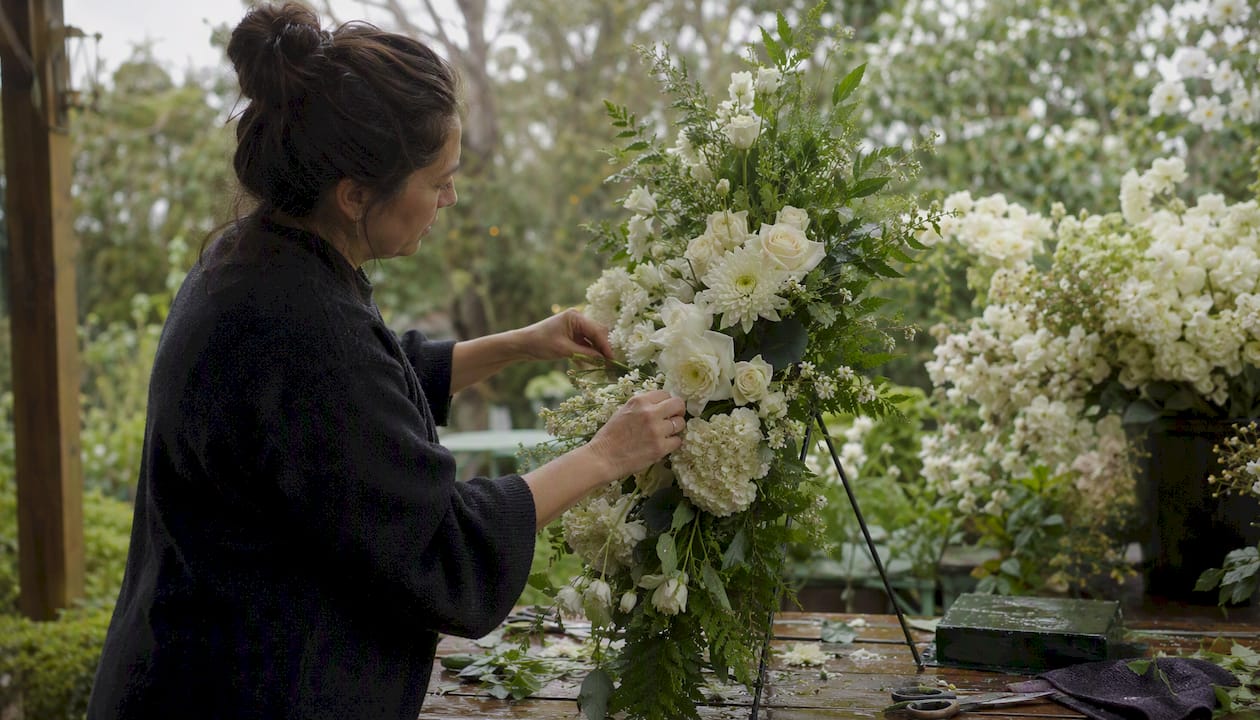
Send formal funeral tributes — standing sprays, casket sprays, wreaths — directly to the funeral home or place of worship. Send smaller sympathy bouquets or plants to the family’s home after the service. That’s the core rule of funeral flower etiquette in Canada, and getting the destination right matters just as much as the flowers themselves.
Before you order anything, run through this short checklist:
- Check the obituary first. If it says “in lieu of flowers,” honor that request with a donation to the named charity instead of sending flowers.
- Confirm the funeral home name and full address — not just the city.
- Get the deceased’s full legal name so the venue can match your tribute to the correct service.
- Find out the service start time. Deliveries to a funeral home should arrive at least 2 hours before the service begins.
- Note a contact number for the funeral director in case the florist needs to coordinate placement.
Malikflowers handles sympathy and funeral orders across Metro Vancouver, including same-day delivery when timing is tight.
Key Takeaways
Funeral flower etiquette in Canada comes down to one rule: send formal tributes to the venue, smaller sympathy arrangements to the home, and always check the obituary before ordering.
| Point | Details |
|---|---|
| Venue vs. home distinction | Send standing sprays and casket arrangements to the funeral home; sympathy bouquets and plants go to the family’s home. |
| Check the obituary first | If it says “in lieu of flowers,” donate to the named charity and send a card noting the contribution. |
| Delivery timing | Target arrival at least 2 hours before the service; order 24–48 hours ahead for custom pieces. |
| Match scale to relationship | Immediate family orders main tributes; friends and colleagues choose smaller baskets, bouquets, or plants. |
| Malikflowers for Metro Vancouver | Malikflowers offers handcrafted sympathy arrangements with same-day delivery and a satisfaction guarantee across Metro Vancouver. |
Table of Contents
- Who should send which size of arrangement?
- What types of funeral arrangements are there, and when do you use each?
- What should you write on the card, and how do you address the delivery?
- When should you send funeral flowers, and how does delivery work?
- Religious and cultural considerations for funeral flowers in Canada
- Which flowers and colors are appropriate for a funeral?
- How much should you spend on funeral flowers in Canada?
- When flowers aren’t appropriate: respectful alternatives
- A florist’s practical checklist for ordering funeral flowers
- What most people get wrong about funeral flower etiquette
- Malikflowers handles sympathy and funeral orders across Metro Vancouver
- Sources
- FAQ
Who should send which size of arrangement?
Your relationship to the deceased determines the scale of what you send, and getting that calibration right keeps the gesture appropriate rather than awkward.
Immediate family coordinates the largest, most central tributes: casket sprays, full-couch covers, and the primary standing arrangements placed near the casket or urn. These pieces are typically ordered through the funeral home itself or a designated family florist. If you’re immediate family, you’re likely already in that conversation.
Close friends and extended family typically send standing sprays, wreaths, or sizable baskets. These go to the funeral home and are displayed alongside the family tributes. A well-chosen standing spray from a close friend reads as a meaningful, visible gesture without overstepping.
Colleagues, acquaintances, and distant friends should choose smaller sympathy bouquets, tabletop baskets, or potted plants. According to FSN Funeral Homes, larger and more elaborate arrangements are reserved for close family; acquaintances do better with something modest and tasteful. A smaller arrangement sent with a sincere card often lands better than an oversized tribute from someone the family barely knows.
When in doubt, go smaller. A $90 basket with a heartfelt note carries more weight than a $250 spray from someone who wasn’t close.
Pro Tip: If you’re part of a workplace group, pool contributions and send one well-chosen arrangement rather than several small ones from individuals. Coordinate through a single point of contact and specify “from the team at [Company Name]” on the card so the family knows it’s a collective gesture.
What types of funeral arrangements are there, and when do you use each?
Different arrangements serve different purposes, and sending the wrong type to the wrong location creates logistical headaches for the funeral home staff.
| Arrangement Type | Typical Use | Best Sent To |
|---|---|---|
| Casket spray | Placed directly on top of the casket; ordered by immediate family | Funeral home |
| Standing spray / easel | Large display piece on a stand; from family or close friends | Funeral home |
| Wreath | Circular tribute; formal and traditional | Funeral home |
| Sympathy basket | Tabletop arrangement; suitable for home or service | Home or funeral home |
| Sympathy bouquet | Smaller, informal; comfort gift for the family | Family’s home |
| Potted plant | Long-lasting living tribute | Family’s home |
| Urn arrangement | Scaled to sit near or around the urn display | Funeral home (urn service) |
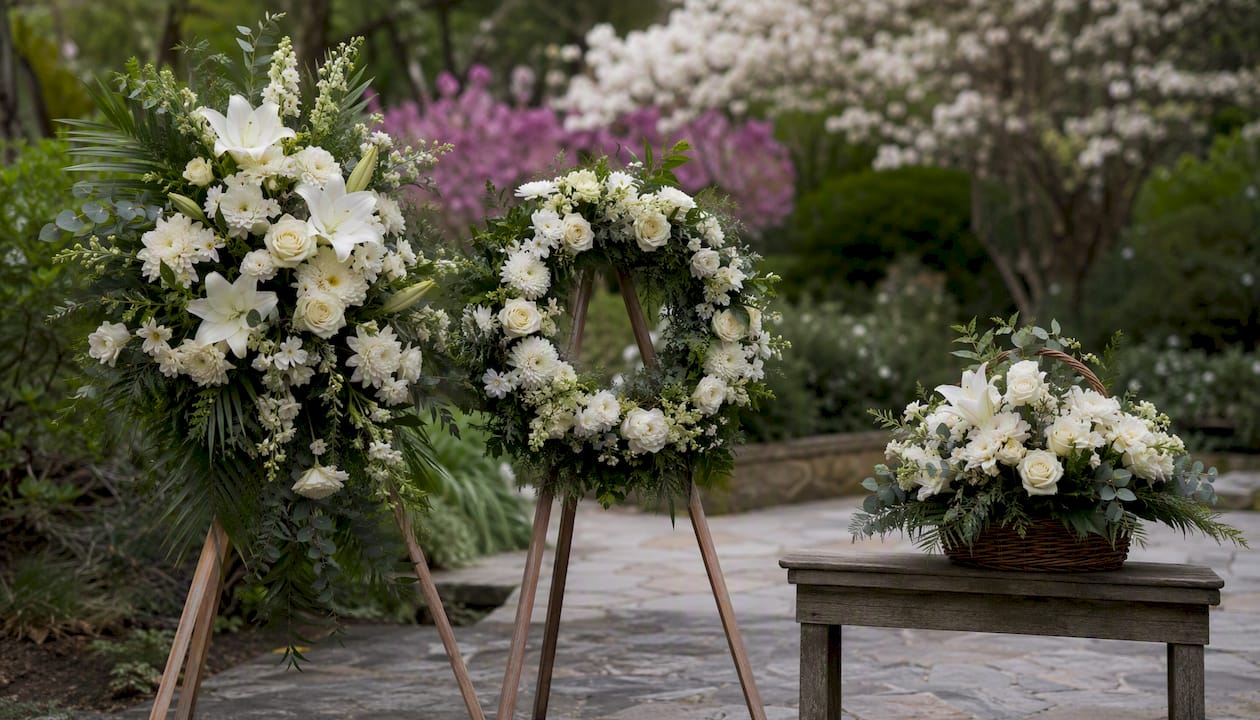
A few practical notes on this list. Standing sprays are designed for easels and look striking in a chapel, but they’re not built for home delivery. Never send a standing spray to a private residence without checking with the family first — it can overwhelm a living room and has no practical stand. For urn services, ask your florist whether the urn will be on a pedestal and what size arrangement would frame it appropriately rather than dwarf it.
On disposition: after the service, venue flowers are typically transferred to the gravesite, taken home by the family, or donated to a hospital or care facility. Some funeral homes ask families in advance. If the flowers matter to you beyond the service, mention it to the family or funeral director.
For multi-day viewings, standing sprays can dry out quickly because they often lack a direct water source. Arrangements with floral foam or a water-holding basket stay hydrated longer and hold up better across two or three days. Potted plants are the most practical choice for extended viewings.
What should you write on the card, and how do you address the delivery?
Keep the message short and always include your name. Families receive dozens of tributes and need to know who sent each one. According to Eirene, a brief, sincere phrase with the sender’s name is all that’s needed.
Card message templates:
- “With deepest sympathy — [Your Name]”
- “In loving memory of [Deceased’s Name]. Thinking of you — [Your Name]”
- “Our hearts are with you during this difficult time. — [Your Name and Family]”
- “[Deceased’s Name] will be deeply missed. With love — [Your Name]”
- “Sending our condolences to the [Family Surname] family — [Your Name]”
- “With sympathy from the team at [Company Name]” (for a workplace tribute)
- “We are so sorry for your loss. Please know we are thinking of you — [Your Name]”
Addressing a funeral home delivery:
When you place the order, give the florist this exact information:
- Funeral home name and full address
- “For the service of [Full Legal Name of Deceased]”
- Service date and start time
- Funeral director’s contact number
A delivery label might read: “[Funeral Home Name], 123 Main Street, Vancouver — For the service of Margaret Anne Chen, Saturday, 11:00 AM. Contact: [Director’s Name], 604-555-0100.”
If you’ve made a donation instead of sending flowers, note it on a card to the family: “In honor of [Deceased’s Name], a donation has been made to [Charity Name] in their memory — [Your Name].”
When should you send funeral flowers, and how does delivery work?
Timing is where most people make mistakes. A beautiful arrangement that arrives after the service has already started is a logistical problem for funeral home staff, not a comfort.
Order well in advance before the service when possible. Same-day delivery is available from many florists across Canadian cities, but custom tributes — standing sprays, casket arrangements — need preparation time. Rushing a custom piece increases the chance of substitutions.
For funeral home delivery, target arrival at least 2 hours before the service start time. That window gives staff time to place the arrangement properly before guests arrive.
What to give your florist when ordering:
- Funeral home name and full street address
- Full name of the deceased (exactly as it appears in the obituary)
- Service date and start time
- Funeral director’s name and phone number
- Any family preferences noted in the obituary (color requests, “in lieu” instructions, specific flowers)
Sample delivery label you can copy:
Pro Tip: If you’re sending flowers to the family’s home after the service, wait 24–48 hours after the service date. The family is often not home during the service itself, and a delivery that arrives at the door while they’re at the chapel adds stress rather than comfort.
Religious and cultural considerations for funeral flowers in Canada
Canada’s cultural diversity means funeral flower etiquette varies significantly by faith and community. What’s appropriate for one family may be unwelcome for another.
Common faith-based guidelines:
- Christian traditions (Catholic, Protestant, Anglican): flowers are widely accepted and expected. White lilies, roses, and carnations are traditional.
- Jewish traditions: flowers are generally not sent to the funeral or shiva. A donation to a charity named in the obituary, or food for the family, is the preferred gesture.
- Muslim traditions: flowers at the funeral are not customary. Donations or food for the bereaved family are more appropriate.
- Buddhist traditions: white flowers are commonly used; avoid red, which can carry associations with celebration rather than mourning in some communities.
- Hindu traditions: white and yellow flowers are generally appropriate; avoid red and avoid strongly scented flowers at some services.
- Sikh traditions: flowers are generally acceptable, though donations to a named charity are also welcomed.
When an obituary says “in lieu of flowers,” standard etiquette is to donate to the specified charity rather than send flowers. Verify the exact charity name and fund before donating — check the obituary carefully, and if the details are unclear, contact the funeral director or the charity directly to confirm the family’s designated fund.
A note on Indigenous protocols in Canada: practices vary widely across First Nations, Métis, and Inuit communities and are not uniform. When in doubt, ask a family member directly or consult the funeral director. Assuming a universal protocol is the most common mistake.
For Chinese funeral traditions in Vancouver specifically, white flowers — particularly white chrysanthemums and white lilies — are traditional and appropriate. Avoid red and pink, which carry celebratory associations. Yellow chrysanthemums are also commonly used.
Which flowers and colors are appropriate for a funeral?
White is the safest starting point. White lilies symbolize peace and restored innocence; white roses convey reverence and remembrance. Both are widely accepted across most Canadian funeral traditions.
Traditionally appropriate choices:
- White lilies (peace, purity)
- White or cream roses (respect, remembrance)
- White carnations (pure love, remembrance)
- Chrysanthemums (widely used in many cultures; white is preferred)
- Gladioli (strength of character)
- Orchids (eternal love, sympathy)
Soft pastels — pale lavender, blush, soft yellow — are generally appropriate and add warmth without feeling celebratory. Avoid bold, saturated colors like hot pink, bright orange, or vivid red unless the family has specifically requested a colorful “celebration of life” service. At those services, the family often notes color preferences in the obituary or service announcement.
For sustainability, potted plants and locally grown seasonal blooms are worth considering. A potted orchid or a small herb garden lasts weeks or months after the service and gives the family something living to tend. Malikflowers’ spring collection includes seasonal blooms that work well for sympathy arrangements when the family has requested something less formal.

How much should you spend on funeral flowers in Canada?
Price ranges vary by city, season, and flower selection, but these bands reflect typical Canadian market pricing:
| Arrangement | Typical Price Range (CAD) |
|---|---|
| Small sympathy bouquet or plant | $70–$120 |
| Mid-range basket or tabletop arrangement | $120–$250 |
| Standing spray or casket arrangement | $150–$300 |
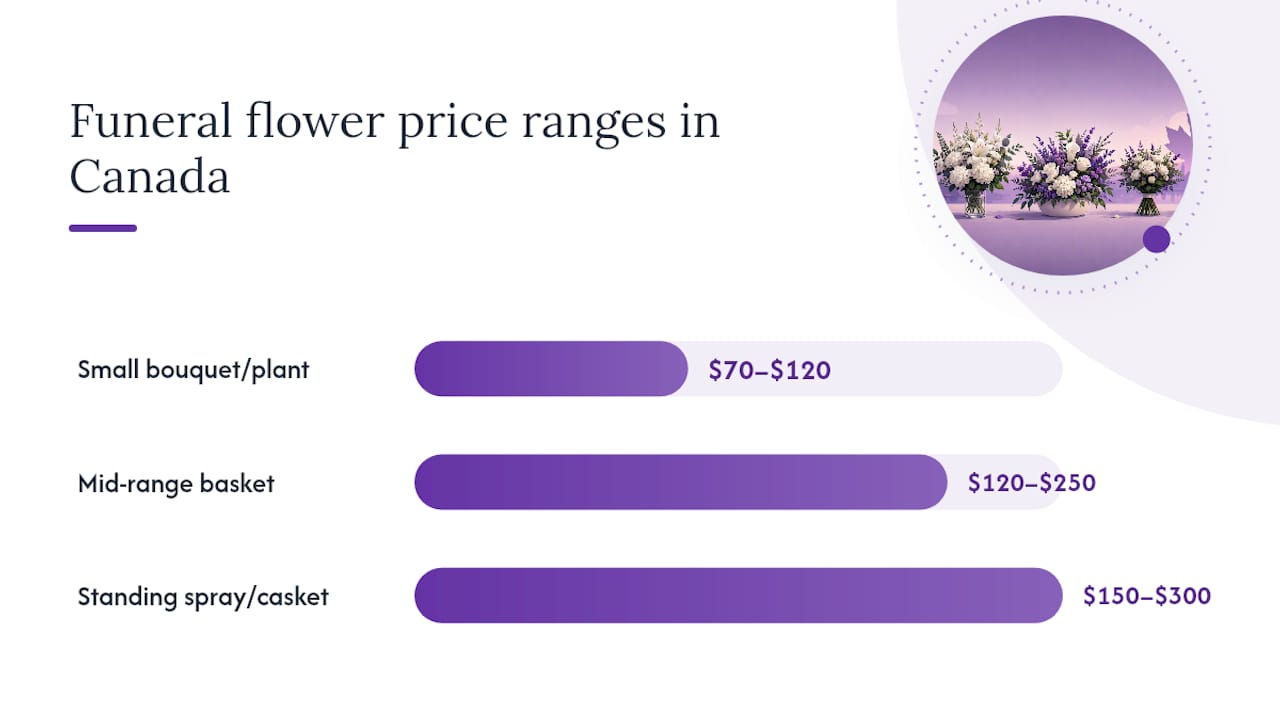
These figures come from Canadian Funerals’ ordering guide, which notes that price varies by city, season, and flower selection.
For group gifts from a workplace or friend group, pool contributions through one person and place a single order. Specify the group name on the card (“From the team at [Company Name]”) and give the florist a clear budget. A $200 arrangement from a group of ten colleagues is more impactful than ten $20 contributions sent separately.
The gesture matters more than the amount. A $80 basket with a thoughtful card from someone who knew the deceased well means more than a $300 spray from a distant acquaintance. Match your budget to your relationship and your means.
When flowers aren’t appropriate: respectful alternatives
Sometimes the right answer is not flowers at all. Three situations call for an alternative:
- The obituary explicitly requests donations in lieu of flowers.
- The family’s faith or cultural tradition does not welcome flowers.
- The family has made a specific request for practical support.
Alternatives that are genuinely useful:
- Verified charity donation: Find the charity named in the obituary, confirm the fund name, and donate directly. Send the family a card noting the donation.
- Memorial fund contribution: Some families set up a GoFundMe or a named fund through the funeral home. The obituary usually includes the link.
- Food and household gifts: A meal delivery, a grocery gift card, or a prepared food basket for the household is practical and deeply appreciated in the days after a service.
- Living plant: A potted orchid, peace lily, or succulent arrangement lasts far longer than cut flowers and requires minimal care.
- Practical help: An offer to run errands, help with childcare, or coordinate meals for the family is often more valuable than any gift.
When noting a donation on a card, keep it simple: “In memory of [Name], a donation has been made to [Charity Name]. With sympathy — [Your Name].” If you’re close to the family and your budget allows, FSN Funeral Homes notes that sending both a small bouquet and a donation is entirely appropriate when a family has requested “in lieu of flowers.”
A florist’s practical checklist for ordering funeral flowers
Before you place the order, confirm these details with your florist:
- Delivery destination: funeral home (with full address and director contact) or family home?
- Deceased’s full name: exactly as it appears in the obituary.
- Service date and start time: so the florist can target a 2-hour-before arrival.
- Obituary instructions: any “in lieu of flowers” language, color preferences, or specific requests.
- Venue restrictions: some chapels have limited floor space or specific placement rules.
- Viewing duration: if the service runs multiple days, ask for arrangements with floral foam or a water source to keep them fresh.
Questions worth asking your florist directly:
- “Will this arrangement be suitable for the service space, or is it too large?”
- “Can you add floral foam or a water source for a multi-day viewing?”
- “Is this design appropriate for an urn service, or should we scale it differently?”
- “Can you include a delivery label with the service details?”
Malikflowers offers same-day sympathy deliveries across Metro Vancouver and will work with you on the delivery label and timing. If you’re unsure which arrangement fits the situation, the team can help you choose something appropriate for the relationship and the service type.
Pro Tip: For urn services specifically, ask whether the urn will be on a pedestal or a table, and what the surrounding space looks like. A florist who knows the display context can design something that frames the urn rather than competes with it.
What most people get wrong about funeral flower etiquette
The most common mistake isn’t choosing the wrong flower. It’s sending the right flowers to the wrong place.
A standing spray delivered to a family’s apartment because someone assumed “flowers go to the house” creates a real problem: the family has no easel, no space, and no way to display it. The gesture becomes a burden. The venue-versus-home distinction isn’t a formality — it’s a practical rule built around how each arrangement type is physically designed to be used.
The second most common mistake is ignoring the obituary. “In lieu of flowers” is a direct request from the family, not a suggestion. Sending flowers anyway — even with good intentions — puts the family in the awkward position of receiving something they specifically asked not to receive. A donation to the named charity, noted on a card, is always the more respectful choice.
What actually matters to grieving families is the acknowledgment. A $75 plant with a handwritten card from someone who genuinely knew the deceased will be remembered long after a $250 arrangement from a distant acquaintance is forgotten. The intention behind the gesture carries more weight than its price or scale.
Malikflowers handles sympathy and funeral orders across Metro Vancouver
When you need a sympathy arrangement that arrives on time, looks right for the occasion, and comes with a guarantee, Malikflowers is the practical choice for Metro Vancouver. Every arrangement is handcrafted to order, not pulled from a cooler, and same-day delivery is available when timing is tight.

The satisfaction guarantee means if the design doesn’t meet your expectations, Malikflowers will make it right. For funeral and sympathy orders, that assurance matters: you’re placing an order during a stressful time and can’t always preview the final piece. Browse the sympathy and funeral collection to see current arrangement options, or visit the full product catalog to compare sizes and price points. When you’re ready to order, the sympathy page includes delivery label guidance and a direct line to confirm service details with the team.
Sources
- Ordering Funeral Flowers in Canada: A Complete Guide
- Funeral terminology and etiquette (FSN Funeral Homes)
- Eirene
FAQ
What are the basic rules for sending funeral flowers?
Send formal tributes (standing sprays, casket arrangements) to the funeral home at least 2 hours before the service, and smaller sympathy bouquets or plants to the family’s home. Always check the obituary first — if it requests donations in lieu of flowers, honor that instead.
Do you write the deceased’s name on funeral flowers?
Yes. Include the deceased’s full name on the delivery order so the funeral home can match your tribute to the correct service. On the card itself, a short message with your own name is standard — for example, “In loving memory of [Name] — [Your Name].”
What colors should you avoid for funeral flowers?
Avoid bold, celebratory colors like hot pink, bright orange, and vivid red unless the family has specifically requested a colorful celebration-of-life service. White, cream, and soft pastels are appropriate across most Canadian traditions.
What is the 3:5:8 rule for flowers?
The 3:5 rule is a floral design proportion guideline, not a funeral etiquette standard. It refers to arranging stems in odd-number groupings at varying heights for visual balance. It applies to the florist’s design process, not to what you send or how much you spend.
Can you send flowers to a cremation or urn service?
Yes. Ask your florist to design a piece scaled to the urn and the display space. Mention whether the urn will be on a pedestal or a table so the arrangement frames it appropriately rather than overwhelms it.