
Research Backed Office Flower Subscription Playbook for Managers
Research Backed Office Flower Subscription Playbook for Managers

Yes. A well-run office flower subscription reliably lifts workplace mood, projects a sharper image to visitors, and does it with less hassle than ordering bouquets whenever someone remembers to. The smartest move is a short pilot with built-in scent and allergy safeguards before rolling it out floor-wide.
TL;DR:
- Weekly or biweekly flower deliveries maintain arrangement freshness, maximize mood benefits, and prevent declining appearance over time.
- Low-allergen and scent-free options should be prioritized to accommodate workplace sensitivities and avoid allergy issues.
- Short exposure to fresh flowers can physiologically reduce stress, but removing plants can diminish perceived attention and satisfaction over time.
- Pilot programs should focus on a small scope, clear timelines, and measurable employee feedback to determine long-term viability.
- Consistent, well-maintained floral arrangements create enduring workplace impressions and cultural routines that support employee well-being and office image.
Table of Contents
- Office Flower Subscription Benefits Worth Knowing
- How Office Flower Subscriptions Actually Work
- What the Research Actually Shows About Flowers at Work
- Allergies, Scents, Maintenance, and Cost: What to Watch For
- Piloting a Subscription: A Step-by-Step Plan
- Who’s Behind This Playbook
- Why the Usual Advice on Office Flowers Falls Short
- Start a Pilot With Malik Flowers
- Sources
- FAQ
Office Flower Subscription Benefits Worth Knowing
The business case for fresh flowers in a workplace rests on four legs: mood, image, culture, and consistency. Each one shows up in research or in plain operational logic, and together they explain why more office managers are treating flowers as infrastructure rather than decoration.
Start with mood. Viewing fresh roses for a few minutes raised parasympathetic nervous activity and produced subjective feelings of relaxation in office workers, according to a controlled study rose-viewing study. That is not a spa treatment. It is a coffee-break-length glance at a desk arrangement, and it still moved a physiological marker of stress recovery.
Client impressions matter just as much as internal morale. A lobby or conference room with a fresh, well-maintained arrangement signals attention to detail before anyone says a word. Field research across multiple organizations found improvements in perceived privacy and workspace attractiveness after plant interventions, with some effects persisting for months multiple organizations.
There is also a cultural layer. Recurring flowers give teams a shared, low-stakes ritual, a reason to notice the front desk changed again, a small thing to compliment during a client walkthrough.
Here is where the four benefits play out in practice:
- Mood and stress relief: short viewing periods measurably calm the nervous system.
- Client impressions: fresh, current displays read as professional and cared-for.
- Team culture: recurring blooms create small, positive shared moments.
- Operational consistency: a subscription guarantees the lobby never looks tired or forgotten.
Quick fact: A brief, focused look at fresh flowers is enough to shift a physiological stress marker, according to the rose-viewing study cited above. That is a lower bar for benefit than most wellness programs clear.
The last point, consistency, is the one office managers underrate. A single impressive bouquet ordered for a big client meeting looks great for four days, then wilts, then sits there looking worse than having nothing at all. A subscription removes that decline curve entirely.
How Office Flower Subscriptions Actually Work
Every vendor structures service slightly differently, but the decisions boil down to four questions worth asking before you sign anything.
- Pick a frequency. Weekly delivery keeps arrangements at peak freshness and maximizes the mood benefit from short, repeated exposures. Biweekly balances visual impact against cost. Monthly works for lower-traffic spaces where budget matters more than constant freshness.
- Decide on customization. Seasonal color palettes, scent-free or low-allergen blooms for shared desks, and size variation between a statement lobby piece and a modest reception-desk arrangement all belong in the conversation. Malik Flowers’ seasonal collections illustrate how palettes shift through the year without sacrificing consistency.
- Choose a service level. Options typically range from delivery-only (someone unboxes it) to full install-and-arrange, plus swap-out service that removes fading stems on a schedule.
- Lock the service agreement. Get the delivery window, replacement policy, and flexibility for holidays or office closures in writing before the first shipment arrives.
What the Research Actually Shows About Flowers at Work
Lab results and field results tell slightly different stories, and knowing the gap matters more than knowing either number alone.
In controlled settings, short exposures to blue and purple flowering plants increased parasympathetic activity and positive mood ratings office-like environment study. Another study introducing living plants into individual offices showed significant increases in perceived attention, creativity, and productivity, with removal of plants causing decreases in these measures Reading biophilic design researchclean%20version%20FINAL%20with%20tables%20and%20figures%20included.pdf).
Quick fact: That removal effect is the single most useful data point for anyone deciding between a subscription and a one-time purchase. The benefit is not just adding plants. It is not taking them away.
Field studies show robust cognitive and mood effects indoors under controlled conditions but report mixed results on productivity in real offices. Factors like exposure duration, plant placement, and workplace type influence outcomes laboratory versus field outcomes.
The practical takeaway: expect reliable gains in mood and perceived attractiveness. Treat productivity gains as a possible bonus, not a guaranteed metric, and design your pilot expectations accordingly.
- Lab conditions: strong, consistent effects on mood and perceived cognition.
- Field conditions: attractiveness and satisfaction gains hold up; productivity results vary.
- Consistency (a subscription’s core advantage) is what keeps the removal-decline effect from happening in your own office.
Allergies, Scents, Maintenance, and Cost: What to Watch For
Every office manager who skips the prep work eventually deals with someone’s sinuses or a stained conference table. A little planning avoids both.
Run a quick allergy and scent survey before the first delivery. Flowering plants can cause allergic reactions or problems for some workers; choosing low-allergen options and offering scent-free arrangements is recommended research on office plant relationships. Guidance on selecting low-allergen and scent-free flower varieties can help avoid workplace fragrance sensitivity issues safe blooms for coworkers.
- Choose low-allergen, low-fragrance varieties for shared desks and communal spaces.
- Reserve stronger-scented or showier blooms for lobbies and meeting rooms with better ventilation.
- Decide upfront who handles spilled water or damaged furniture, and get it in the service agreement.
- Budget by square footage and traffic level, not by guesswork. A pilot in one lobby costs far less than committing to every floor at once.
- Ask vendors about seasonal, locally sourced stems and what they do with clippings and packaging waste.
Pro Tip: Put the scent-free option in writing as a standing default for desk-level deliveries, and let employees opt into stronger fragrances for their own space instead of opting out of a strong default.
If your goal is specifically to affect perceived air dryness, know that the humidity-related studies used plant volume scaled to office size. A few decorative stems on a reception counter will not move that particular needle, even though they will still do plenty for mood and appearance.
Piloting a Subscription: A Step-by-Step Plan
A pilot only works if you set the finish line before you start.
- Scope it small. Pick one lobby, one breakroom, or one floor rather than the whole building. Six to twelve weeks is long enough to see real patterns, since some perceptual effects take months to stabilize.
- Get signoffs first. Confirm budget approval, run the allergy and scent survey, and let employees opt in or flag concerns before the first delivery date.
- Confirm the schedule in writing. Delivery windows, swap-out timing, and a point of contact for damaged or wilted arrangements all need to be settled before week one.
- Measure with two short surveys. A brief pre-pilot and post-pilot employee survey, plus a simple perceived-attractiveness rating from staff and visitors, gives you real decision data without turning this into a research project.
- Set your scaling threshold in advance. Decide what cost-per-visible-area and satisfaction score justify expanding to more floors, and what result means you should adjust vendor, frequency, or placement instead.
Facilities-style recurring service scheduling, the kind used for grounds and lawn care contracts, follows the same logic: consistent schedule, clear replacement terms, simple evaluation checkpoints.
Who’s Behind This Playbook
This guide comes from Reza, writing from Malik Flowers’ vantage point after years of building recurring floral programs for offices across Metro Vancouver. Malik Flowers handcrafts every arrangement, backs each delivery with a satisfaction guarantee and refund if a design misses the mark, and structures office pilots around flexible frequency and scent-aware customization rather than a fixed one-size package.
Why the Usual Advice on Office Flowers Falls Short
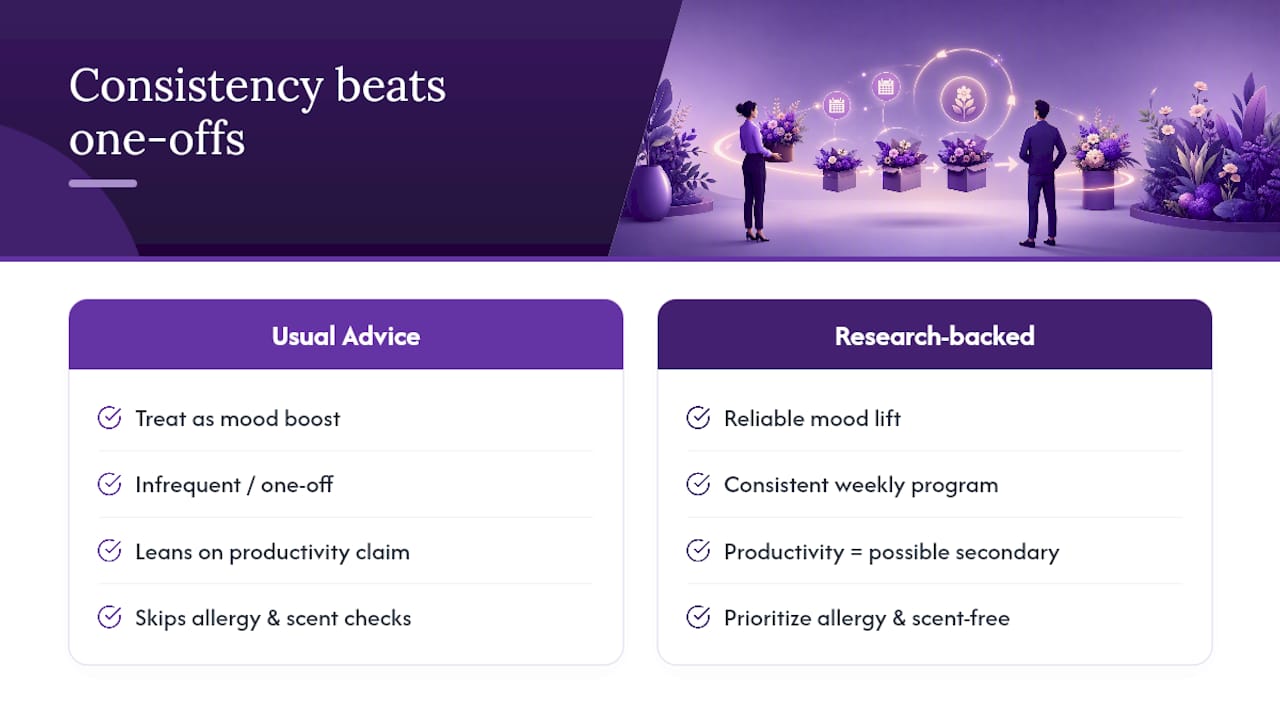
Most advice on this topic treats flowers as a nice-to-have mood boost and stops there. That undersells what the research actually supports, and it also skips the one variable that determines whether an office program works at all: consistency. The removal-effect finding from the Reading biophilic study is the most important number in this entire topic, and almost nobody who writes about “office flowers” mentions it. A one-time bouquet before a big client visit is worse than doing nothing consistently, because the decline itself becomes visible.
The conventional advice also overpromises on productivity. Treat that as a possible secondary benefit, not the pitch you take to your finance team. The pitch that survives scrutiny is simpler: reliable mood lift, better first impressions, and a workplace that looks cared for every single week instead of once a quarter. Prioritize the allergy survey and the scent-free default before you prioritize picking pretty colors. Get that foundation wrong and no arrangement, however striking, will save the program.
— Reza
Start a Pilot With Malik Flowers
A subscription solves the exact problem this article has been walking through: mood and image benefits only hold up when the flowers stay consistent, and a one-off order can’t deliver that. A vendor builds each arrangement by hand for Metro Vancouver offices, backs every delivery with a satisfaction guarantee and refund if the design doesn’t land, and can tailor frequency, size, and scent-free options to whatever floor or lobby you’re piloting.
Browse the subscription options to see frequency and customization choices, or look through the current product catalog for arrangement styles that fit a lobby versus a breakroom. Ready to test it on one floor first? Request a tailored pilot plan and get your first delivery scheduled this month.
Sources
- The physiological and psychological relaxing effects of viewing rose flowers in office workers
- Effects of viewing flowering plants on employees’ wellbeing in an office-like environment
FAQ
Are office flower subscriptions worth it?
Yes, for most offices. The evidence points to real mood and stress benefits from brief exposure to fresh flowers, plus a consistent, professional appearance that a one-time bouquet can’t sustain.
How does an office flower subscription work?
You choose a delivery frequency (weekly, biweekly, or monthly), a service level (delivery-only through full install and swap-out), and customization details like scent-free options or seasonal palettes, then the vendor handles the recurring schedule.
What is the best monthly flower subscription for an office?
The best fit depends on traffic and budget. High-visibility spaces like lobbies benefit most from weekly service, while lower-traffic areas can run on a monthly schedule without losing much impact.
Which is the best flower subscription for a workplace?
Look for a vendor offering scent-free or low-allergen options, a clear replacement policy, and flexible frequency. Malik Flowers structures its office subscription service around exactly those requirements for Metro Vancouver businesses.
Do flowers really reduce stress at work?
Short viewing periods of fresh flowers, as brief as three to four minutes, have been shown to raise parasympathetic nervous system activity and increase self-reported relaxation in controlled office studies.