
Card Ready Sympathy Flower Messages: Examples and Canadian Etiquette
Card Ready Sympathy Flower Messages: Examples and Canadian Etiquette

The safest sympathy flower message names the person who died, says something true about them in one sentence, and closes with a specific offer instead of “let me know if you need anything.” Something like: “Sending love as you remember your mom’s laugh. I’m bringing dinner Thursday, no need to reply.” It works because it’s sincere, personal, and short enough to fit on a card without feeling rushed or hollow.
TL;DR:
- Personalize messages by naming the deceased, highlighting a specific memory or quality, and including a concrete offer of help to reduce the recipient’s burden.
- Keep flower cards brief with one or two sentences, focusing on sincerity, the tone suitable for your relationship, and avoiding vague or dismissive phrases.
- Avoid common condolence lines that minimize grief, such as “I know how you feel” or “They are in a better place,” and instead opt for honest, supportive language.
- Offer specific acts of assistance, like bringing dinner or covering shifts, rather than generic phrases that require the grieving person to ask for help.
- Use plain language, ensure correct spelling of names, and be aware of cultural or regional flower symbolism to communicate respect and avoid unintended offense.
Table of Contents
- Sympathy Flower Card Messages That Fit a Small Card
- Longer Sympathy Card Messages You Can Adapt
- Sympathy Messages by Relationship
- Phrases That Sound Comforting but Aren’t
- Turning “Let Me Know if You Need Anything” Into Real Help
- Funeral Flower Cards vs. Sympathy Cards
- How Malikflowers Approaches Sympathy Deliveries
- Writing Sympathy Messages Across Cultural Lines
- Why Simple Words and Follow-Through Matter More Than Perfect Phrasing
- Send Sympathy Flowers With a Message That Fits
- Sources
- FAQ
Sympathy Flower Card Messages That Fit a Small Card
Flower cards give you two or three lines, maybe four if the florist’s handwriting is small. That constraint is actually a gift. It forces you past the throat-clearing and into something real.
Pick your tone first, then the wording follows fast. Here’s how to sort the short options.
Classic and neutral (safe for most relationships, including ones where you’re not sure how religious the family is):
- “With deepest sympathy for your loss.”
- “Thinking of you and your family during this difficult time.”
- “Wishing you comfort and peace in the days ahead.”
Religious (use only when you know the family’s faith practices support this language):
- “Praying for peace and strength for your family.”
- “May God’s comfort surround you in this time of grief.”
- “Holding you in prayer as you grieve.”
Memory-focused (best when you knew the person who died, even briefly):
- “Your father’s kindness touched everyone who met him.”
- “So grateful for the memories we shared with her.”
- “He will be remembered for his generous spirit.”
Support-focused (when you want the emphasis on the living, not just the loss):
- “Here for you, today and in the weeks ahead.”
- “Sending love and strength to you and your family.”
- “You’re not alone. I’m thinking of you constantly.”
Keep flower card lines to one or two sentences. Anything longer belongs on a separate sympathy card, where there’s actual room to say it well.
Longer Sympathy Card Messages You Can Adapt
A sympathy card gives you more space, and a stronger message structure to fill it with: name the deceased, express sympathy, mention a specific quality or memory, then close with a wish or an offer. That four-part shape is what grief counselors recommend, and it works because it forces specificity instead of generic comfort.
For close family:
- “I’ve been thinking about Grandpa constantly since you called. His stories at Sunday dinner made every one of us feel like we mattered. I’m here for whatever you need, big or small, and I’ll call you Thursday just to check in.”
- “There are no words for how much I’ll miss your mother. She taught me to bake bread the summer I turned twelve, and I think of her every time I pull a loaf from the oven. Please let me bring food this week. I’ll text you a day that works.”
For close friends:
- “I keep replaying the last conversation I had with your dad, laughing about that camping trip disaster. He was one of a kind, and losing him leaves a real gap. I’m picking up your kids from school Monday and Wednesday so you have that off your plate.”
For acquaintances or coworkers:
- “I’m so sorry to hear about your loss. Even from our conversations at work, it was clear how much your brother meant to you and how proud he was of your family. Thinking of you during this time, and covering your shifts this week is already arranged.”
Notice each example commits to one specific memory or one specific offer, never both stacked on top of a vague sentiment.
Sympathy Messages by Relationship
Register shifts depending on who you’re writing to and who you’re writing as. A message to a grieving parent reads differently than one signed by an entire department.
- Close friend. Informal, warm, first-name signed. “Thinking of you every day this week. Call me anytime, even at 2 a.m.” Short works here because your friendship already carries the weight.
- Family member. Warmer and more personal, often referencing shared history. “Grandma’s garden will always remind me of her patience with all of us. Sending so much love.” Sign with your first name or a family nickname.
- Colleague. Slightly more formal but still personal if you knew the deceased or the coworker well. “Your dedication to your family was obvious in everything you shared about them at work. Wishing you strength.” Sign with your full name.
- Organization or company-sent flowers. Most formal register, no assumed intimacy. “On behalf of everyone at [Company], please accept our deepest condolences during this difficult time.” Sign as “The team at [Company Name]” rather than an individual, unless one person had a direct relationship with the deceased.
Matching your message to the obituary’s own tone helps too. A celebration-of-life obituary supports a lighter, memory-driven note; a solemn one calls for simpler, quieter language.
Phrases That Sound Comforting but Aren’t
Some of the most common condolence lines actually minimize grief instead of easing it. Avoid these:
- “I know how you feel.” Nobody’s grief is identical to anyone else’s, and the comparison can feel dismissive.
- “Everything happens for a reason.” This implies the loss served some purpose, which rarely lands well.
- “At least they lived a long life.” It skips past the pain in front of you.
- “They’re in a better place.” Only appropriate if you know the family shares that belief.
These phrases are widely flagged by grief and etiquette experts as ones to avoid. Swap “I know how you feel” for “I can’t imagine how hard this is.” Swap “everything happens for a reason” for “I’m so sorry, this is a huge loss.”
Pro Tip: Skip religious language entirely unless you’re certain of the recipient’s faith. “Thinking of you” or “sending strength” work across belief systems and never risk a mismatch.
Turning “Let Me Know if You Need Anything” Into Real Help
That phrase asks a grieving person to do more work: identify a need, then ask for it. Specific offers remove that burden entirely, and research on condolence writing backs this up.
- “I’m bringing dinner Tuesday around 6. I’ll leave it on the porch if you’re not up for company.”
- “I can watch the kids Thursday afternoon so you can rest.”
- “I’ll cover your Saturday shift, already cleared it with your manager.”
- “Running errands this week. Send me your list.”
Only promise what you can actually follow through on. If you’re not sure you can commit weekly, say “I’ll check in Tuesday” instead of “I’m here whenever you need me,” which sounds nice but offers nothing concrete.
Funeral Flower Cards vs. Sympathy Cards
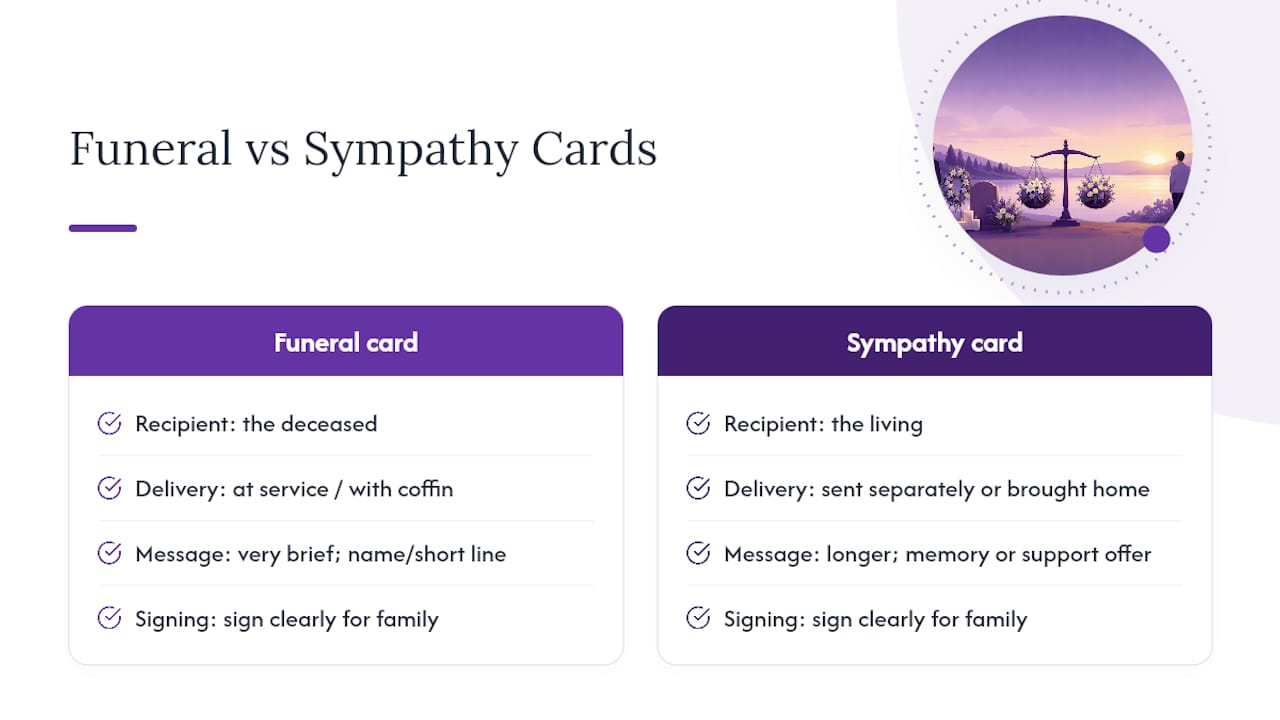
Funeral flower cards are often addressed to the deceased directly and stay brief, sometimes just a name or a short line like “Rest in peace, Grandpa.” Sympathy cards, sent separately or brought to the home, are written to the living and can hold a full memory or offer of support.
If you’re sending a formal floral tribute, sign it clearly so the family knows who to thank later. Before ordering, check the obituary or funeral notice for “in lieu of flowers” requests, and call the funeral home directly if you’re unsure whether flowers are still welcome.
How Malikflowers Approaches Sympathy Deliveries
Malikflowers builds sympathy arrangements by hand, not from a generic template, and backs each one with a satisfaction guarantee and refund if the design doesn’t land right for a difficult moment. The sympathy and funeral flower delivery page lets customers add a custom card message at checkout, so the wording you choose from this guide arrives exactly as written. Same-day delivery across Metro Vancouver means a message can reach someone the day you write it, not days later.
Writing Sympathy Messages Across Cultural Lines
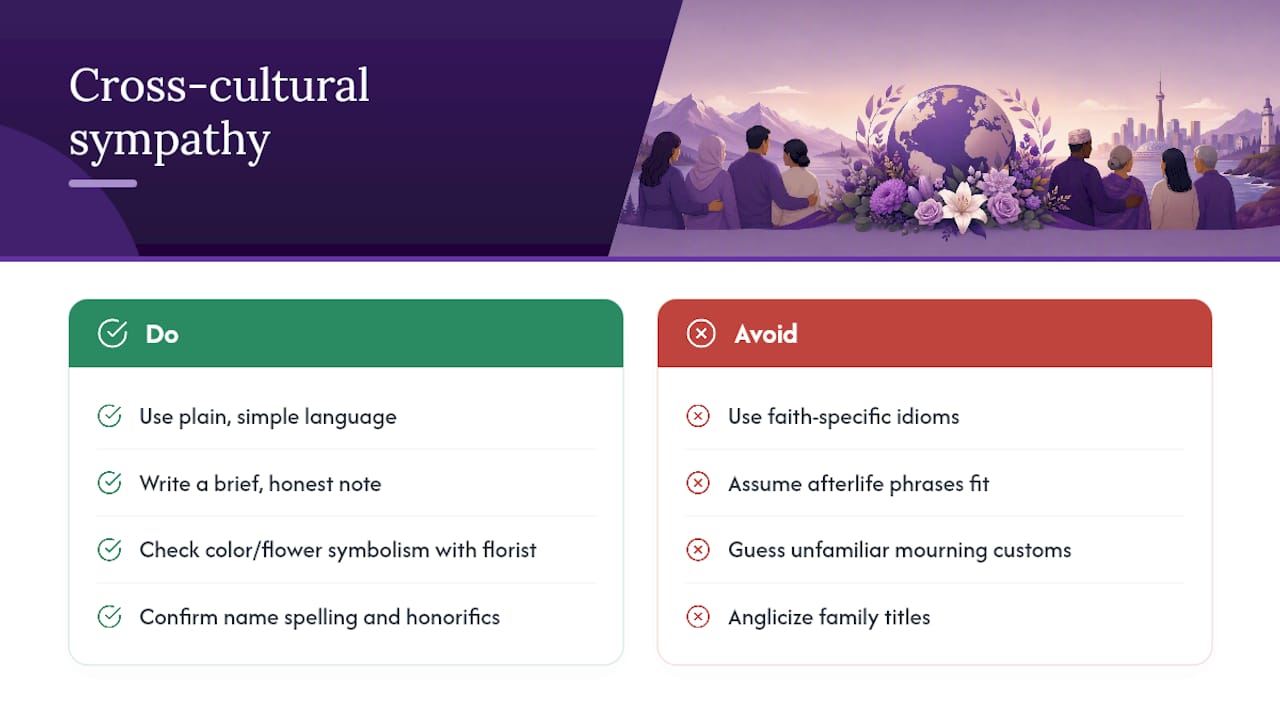
When you don’t know a family’s specific customs, plain language beats guessing. Skip idioms tied to one faith tradition (like “in a better place” or specific afterlife references) unless you know they fit. “Thinking of you,” “holding your family close,” and “sending strength” translate across most cultural and religious lines without risk.
If you’re unfamiliar with mourning customs in the recipient’s culture, a brief, honest note works better than an attempt to imitate language you’re not confident in. Something like “I don’t know all the traditions your family follows, but I wanted you to know I’m thinking of you” reads as respectful rather than presumptuous.
Pay attention to color and flower symbolism, too. White flowers signal mourning in many Western and East Asian traditions, but in some cultures, white carries different associations entirely, and specific flowers, like chrysanthemums, hold funeral-only meaning in parts of Europe and Asia. When in doubt, a florist familiar with regional customs can help you avoid an unintentional misstep. For anyone memorializing a pet rather than a person, pet memorial keepsakes offer another way to acknowledge that particular kind of loss.
Names matter too. Confirm the correct spelling and pronunciation of the deceased’s name before writing it on a card, and if the family uses a title or honorific in their own language, use it rather than defaulting to an anglicized version.
Why Simple Words and Follow-Through Matter More Than Perfect Phrasing
People spend far too long agonizing over the “right” words when the honest, slightly clumsy sentence they meant to send in the first place would have worked fine. Grief doesn’t require eloquence. It requires someone showing up, meaning it, and then actually calling on Thursday like they said they would.
Pick one example from this guide, adjust the name and the memory, and send it today. The follow-through is what people remember, not the sentence structure.
— Reza
Send Sympathy Flowers With a Message That Fits
Malikflowers builds every sympathy arrangement by hand across Metro Vancouver, and backs it with a refund guarantee if the design doesn’t feel right for a moment this sensitive. That’s the real difference from ordering off a generic same-day flower site: your arrangement gets designed for the occasion, not pulled from a standard catalog rotation.

At checkout, you can add any of the messages from this guide, or write your own, and Malikflowers will pair it with fresh, seasonal blooms suited to a sympathy delivery. Browse the sympathy and funeral flower collection now and get same-day delivery to the person who needs to hear from you today.
Sources
- Condolence messages | What to write in a sympathy card
- How to write a condolence note — Arbor Memorial
FAQ
What is a good message to send with sympathy flowers?
A good message names the person who died, states your sympathy plainly, and adds one specific memory or offer of help, such as “Thinking of you as you remember your mother’s warmth. I’m bringing dinner Thursday.”
What should I write on a flower card when someone dies?
Keep it to one or two lines: a simple sympathy statement like “With deepest sympathy for your loss” works, or personalize it with a brief memory if you knew the person.
What is a short, sweet condolence message?
“Wishing you comfort and peace in the days ahead” or “Here for you, today and always” both work as brief, sincere lines that fit almost any flower card.
What are good messages to write in a flower card?
Choose based on tone: classic lines like “With deepest sympathy” suit most situations, memory-focused lines work when you knew the deceased, and support-focused lines like “Sending strength to your family” emphasize the living.
When should I send sympathy flowers or a card?
Send within the first two weeks after the loss when possible, though a sincere message still means something if it arrives later.